





SAP and HPE to Deploy Tabular AI Foundation Model Aboard the International Space Station
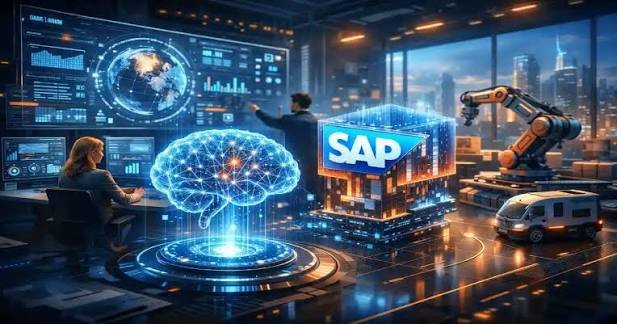
SAP-RPT will run on HPE Spaceborne Computer-2 to detect anomalies and predict failures in orbit, with lessons intended to carry over to enterprise edge AI
SAP today announced the planned deployment of SAP-RPT, its tabular AI foundation model, on HPE Spaceborne Computer-2 aboard the International Space Station (ISS). SAP described it as one of the most significant edge-compute validations of an enterprise AI model to date. The deployment is expected by early 2027.
AI for an unforgiving environment
Spacecraft face radiation, vacuum, debris and solar storms, and onboard sensors generate more time-sensitive data than can be sent back to Earth for analysis. Reducing latency is essential to safety. SAP-RPT makes predictions directly from structured data, even when some values are missing, and does not need the usual model training or fine-tuning.
Running onboard the ISS, the model is planned to support anomaly triage in real-time telemetry, predict issues before failures escalate and reconstruct missing sensor values from historical data. It will also produce explainable mission-health reports for astronauts and ground teams. Planned outputs include predictions for computer and mission health status, an overall mission risk score and an assessment of whether manual intervention is needed.
Efficiency and adaptability
SAP-RPT belongs to SAP’s portfolio of tabular foundation models, alongside TabPFN from Prior Labs, with SAP AI Core orchestrating, managing and governing models, predictions and workflows. While large language models excel at language and reasoning, tabular models are built for the structured data behind real-world operations. SAP says SAP-RPT is about 50,000 times more energy-efficient than state-of-the-art large language models, a significant advantage where every watt is limited, and that it adapts as conditions change without pre-training.
From orbit to enterprise
Mayank Shrivastava, Vice President of Generative AI and Foundation Models at SAP SE, said space is the ultimate stress test, and that a model able to predict failures in orbit can be applied to supplier risk, cash flow anomalies and equipment failures on Earth. [Insert approved direct quote.]
Scott Wiest, Vice President and Global Sales Chief Technologist and HPE Fellow, said the deployment shows what is possible with real-time AI detection and prediction in the ultimate edge environment. [Insert approved direct quote.]
SAP said the same constraints of limited energy, intermittent connectivity and zero tolerance for failure apply to disaster relief, remote agriculture, distributed manufacturing and spread-out supply chains. Insights from the mission will inform its roadmap for enterprise edge AI. The company also sees the work as groundwork for space-based data centres and deep-space exploration.